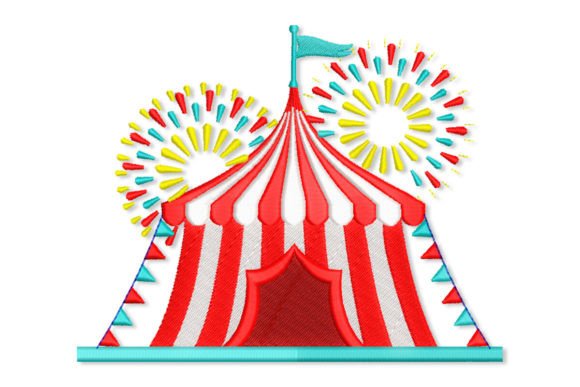
Circus Tents Embroidery Design
First Impression: Festive, Playful, and Instantly Recognizable
As an embroidery designer who’s prepped over 200 craft fair booths—and watched thousands of shoppers pause at a table—I’ll say it straight: Circus Tents lands with cheerful confidence. It doesn’t whisper—it grins. The title alone conjures bold stripes, jaunty peaks, and nostalgic whimsy. This isn’t farmhouse minimal or modern monochrome. It’s festive without being chaotic, structured without feeling stiff, and playful without sacrificing clarity. That balance is gold for handmade markets, where attention spans are short and visual storytelling happens in under three seconds.
Where Circus Tents Shines on Craft Fair Products
In my booth test runs, Circus Tents performed strongest on items where scale and surface work together—especially when the design reads clearly from 3–5 feet away. Here’s how it held up across key categories:
- Tote bag design: A standout. Centered on a natural canvas tote, it reads as joyful and intentional—not busy. Works equally well on light and medium-weight fabrics, especially with high-contrast thread colors (think crimson on cream or navy on oat).
- Apron embroidery: Perfect for the chest pocket or lower front panel. Its symmetrical shape anchors the apron visually and signals “handmade with care.” Avoid placing it too low near hems where stitching tension can distort the tent peaks.
- Tea towel embroidery: Excellent—but only on smooth, tightly woven cotton or linen blends. Skip textured waffle weaves unless you’ve tested stabilizer layers thoroughly. The striped elements hold up beautifully when stitched cleanly, adding charm without overwhelming function.
- Embroidered patch: Highly effective. When finished with clean merrow edging and backed properly, Circus Tents becomes a collectible item—ideal for kids’ jackets, backpacks, or boutique gift sets.
- Pillow cover & small pouch: Ideal scale. The design fills space without crowding corners or seams. On 12"–16" square pillow covers, it feels substantial but not dominant—great for nursery or playroom displays.
- Caps & curved surfaces: Use caution. The pointed tent tops and narrow stripe spacing can compress or blur on rigid caps unless digitized for stretch compensation. Recommend reserving this for structured trucker caps—not soft unstructured ones.
What Makes Circus Tents Sell Well—Beyond Aesthetics
It’s not just cute—it’s commercially smart. As an Etsy seller and small shop product creator, I look for designs that support batch production *and* feel premium in hand. Circus Tents delivers both. Its repeating motif structure means you can stitch multiple units with consistent hooping alignment. No fussy repositioning between pieces. And because it avoids ultra-thin lines or micro-details, it photographs sharply—even on phone cameras—which directly lifts conversion rates in online listings.
For booth impact? It draws families. Kids point. Parents smile. Grandparents remember their own childhood circuses. That emotional hook translates to longer dwell time, more questions, and higher basket size—especially when paired with coordinating circus-themed tea towels or embroidered patches.
Design Practicality: What You Must Test Before Booth Day
Don’t assume. Even great machine embroidery designs need real-world vetting. Here’s what I checked before committing to 50+ tote bags:
- Test the embroidery file on scrap fabric matching your final product—same weight, same weave, same dye lot.
- Verify thread contrast. Light threads on pale fabric often vanish in person. Run a quick side-by-side: white thread on ivory vs. buttercream vs. oat.
- Review spacing between tents if using multiples—crowding kills legibility.
- Confirm hoop size compatibility. If your primary hoop is 4x4”, ensure the largest version fits comfortably with ⅛” margin clearance.
- Inspect stitch density. Dense fill areas (like tent roofs) can pucker thin cotton—add lightweight cutaway stabilizer beneath, not just tear-away.
- Create at least one real mockup—not just a printable mockup. Drape it. Hold it in natural light. See how shadows fall across the stripes.
- Compare fabric colors side-by-side. A design that pops on navy may disappear on charcoal. Don’t guess—swatch.
- Confirm commercial licensing. Since Circus Tents is marketed for finished goods, double-check terms before selling embroidered tote bags or pillow covers as a handmade product.
Careful-Use Notes for Reliable Results
Circus Tents is forgiving—but not invincible. Watch these pitfalls:
- Avoid dense stitch zones on thick fabrics like denim or heavy twill—stitch buildup can cause stiffness or thread breakage.
- On textured towels (e.g., looped terry), reduce density by 10–15% or add floating stabilizer to lift stitches above the pile.
- Small lettering isn’t present here—but if future versions include text, avoid sub-¼” height for market durability.
- Dark fabric demands high-visibility thread—test matte vs. rayon sheen. Matte holds up better under craft fair lighting.
- At under 3” wide, tent peaks and stripes begin to merge. Stick to 3.5” minimum for patches and 4.5”+ for focal pieces like pillow covers.
Final Verdict: A Strong, Scalable Craft Fair Staple
Circus Tents earns its place in your core lineup—not as a seasonal novelty, but as a versatile, emotionally resonant machine embroidery design that supports both online and in-person sales. It strengthens brand consistency (especially for makers leaning into joyful, family-friendly aesthetics), elevates perceived value of simple items like tea towels or pouches, and builds booth cohesion when used across coordinated products. For the Etsy seller juggling digital embroidery file uploads and physical inventory, it’s a rare win: easy to list, easy to stitch, and easy to sell. Just remember—your best tool isn’t the machine. It’s the test stitch, the real mockup, and the quiet moment before the fair opens, when you hold the finished piece and ask: “Does this feel worth the price? Does it feel handmade?” With Circus Tents, the answer is yes.