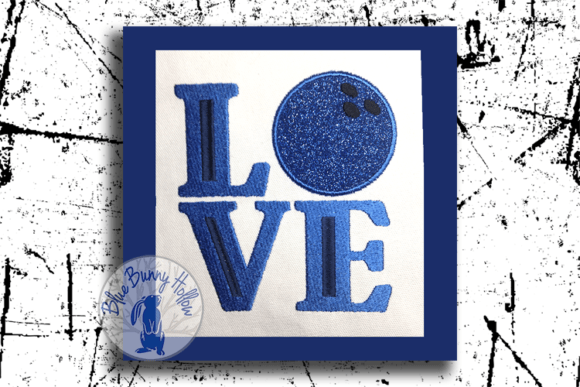
Love Bowling: A Playful, Punchy Embroidery Design That Lands Right
As a designer who’s stitched thousands of embroidery files for clients—from Etsy sellers launching their first embroidered tote line to boutique owners refreshing seasonal kitchen towel collections—I opened Love Bowling expecting charm. What I got was something sharper: wit with weight, simplicity with personality. It’s not just another sports-themed machine embroidery design—it’s a conversation starter built into 12 letters (and one very intentional bowling ball).
First Impressions: Bold, Balanced, and Unmistakably Bowler
The moment you preview Love Bowling, the “O” stops you. It’s not a circle—it’s a textured, dimensional bowling ball, complete with finger holes implied through clever satin stitch placement and subtle contouring. The rest of the lettering is clean, slightly rounded sans-serif—friendly but not childish, sporty but not aggressive. There’s no extra flair, no unnecessary swirls or shadow effects. Just confident spacing, consistent stroke weight, and that single, smart visual twist.
This isn’t a design shouting from the lanes—it’s leaning against the ball return, smiling. It feels equally at home on a dad’s vintage-style sweatshirt as it does on a baby onesie with “Future Strike” stitched beneath in tiny script (though that’s a custom add-on—not part of the base file). Its personality is warm, inclusive, and quietly confident—exactly what makes a handmade product feel personal rather than mass-produced.
Where Love Bowling Shines in Real Projects
I recently prepped Love Bowling for a small-batch run of cotton canvas tote bags for a local bowling alley’s gift shop. We used medium-weight tear-away stabilizer, 40-weight polyester thread, and stitched it centered on the front panel. Result? Crisp, legible, and instantly recognizable—even from across the room. No bleeding, no puckering, no need for re-hooping.
It performed just as well on midweight French terry sweatshirts—no backing distortion, thanks to its moderate stitch density and open letter spacing. On tea towels? Excellent. The design breathes; it doesn’t drown the fabric. As an embroidered patch? Ideal. Its compact footprint (no sprawling flourishes) means it trims cleanly and sews flat onto denim jackets or aprons without bulk.
For Etsy sellers: this is a high-engagement digital embroidery file. Search “bowling gift” or “sports mom embroidery,” and Love Bowling fits naturally into those buyer intents—especially when paired with a clean mockup showing it on a unisex crewneck or a linen pillow cover. It reads clearly in thumbnail size, which matters for scroll-stopping appeal.
Where to Pause—and Test—Before Committing
Love Bowling isn’t magic on every surface. Here’s where your judgment matters:
- Small hoop sizes: It fits comfortably in a 4x4 hoop—but only just. If your machine struggles with tight margins or auto-trim timing, test the full outline first. Don’t assume the ball detail will clear the edge.
- Textured or stretchy fabrics: Avoid using it directly on ribbed knits or slub linens without additional cut-away stabilizer. The bowling ball’s curves rely on smooth fabric tension to read clearly.
- Dark or dense backgrounds: While it works on navy or charcoal, avoid black thread on black fabric unless you’re adding a subtle border or shadow fill. Check contrast in grayscale mockups—some screens flatten the ball’s dimensionality.
- Curved surfaces like caps: The straight-line baseline helps, but the ball’s roundness can distort slightly on low-profile front panels. Consider slight vertical compression (2–3%) if stitching on structured caps.
- Frequent-wash items: Baby onesies or kitchen towels? Confirm stitch density isn’t overly dense in the ball area—tight fills can stiffen after repeated laundering. A quick stitch-count check (if your software shows it) helps.
Design Integrity Meets Customer Trust
What elevates Love Bowling beyond novelty is its restraint. There’s no over-embellished heart, no cartoon flames, no forced puns. That makes it age well—on holiday gifts, wedding party robes (“Team Love Bowling”), or even subtle branding for a women’s league. Customers don’t buy “cute.” They buy authenticity. And this design delivers that through clarity, cohesion, and craft-aware construction.
When your customer sees Love Bowling stitched cleanly on a linen market bag, they don’t just see a phrase—they register intention. That translates directly to perceived value, repeat orders, and word-of-mouth trust. For small shop owners, that’s not just decoration—it’s quiet brand reinforcement.
Practical Designer Notes Before You Stitch
Before sending Love Bowling to your machine—or listing it as part of your craft business inventory—do these six things:
- Test it on scrap fabric matching your final project’s weight and weave.
- Check thread color contrast on both light and dark backgrounds—especially around the ball’s finger holes.
- Review stitch density visually: does the ball feel solid but flexible? Or stiff and heavy?
- Confirm hoop size compatibility—don’t guess. Measure the bounding box in your editing software.
- Inspect small details at 200% zoom: are the finger hole outlines crisp, or do they blur into fill?
- Verify licensing terms—especially if you plan to sell finished products or bundle Love Bowling with other design assets.
And one more thing: try it in a simple black-and-white printable mockup. Sometimes the strongest test of a sports embroidery design isn’t color—it’s whether the idea lands, clear and unmistakable, in silhouette alone. With Love Bowling, it does.
This isn’t just another file in your library. It’s a reliable, resonant piece of design thinking—compact, clever, and ready for real work. Whether you’re stitching for joy, profit, or a very specific bowler who deserves something better than generic clip art, Love Bowling earns its place on the lane.