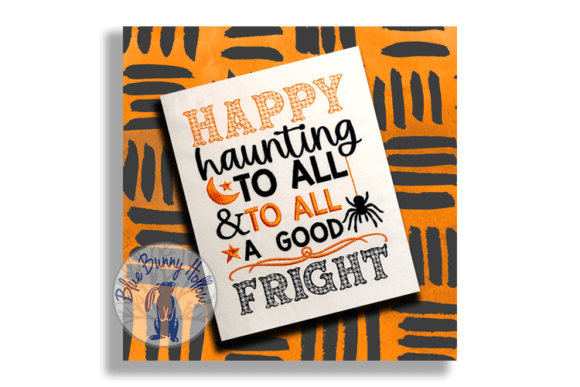
Happy Haunting to All to All a Good
A Strategic Review for Small Business Embroidery Use
As an embroidery designer who’s developed hundreds of commercial designs for cafés, boutiques, bakeries, florists, pet brands, and Etsy sellers, I approach every new machine embroidery design with two questions: Does it reinforce brand identity? and Will it hold up in real-world production? That’s why I took time to review Happy Haunting to All to All a Good not just as a Halloween motif—but as a functional, scalable asset for small business merch.
First Impression: Playful Elegance with Clear Intent
The title itself—Happy Haunting to All to All a Good—immediately signals warm irreverence. It’s not chaotic or overly macabre; it leans into “eerie elegance,” as the description notes. That duality is rare—and valuable. For a local business, this tone reads as friendly yet distinctive, handmade but professional, and seasonal without feeling disposable. Think: a floral shop adding subtle charm to staff aprons, or a bakery stitching it onto cotton tote bags for October pop-ups. It avoids cliché while still landing unmistakably in the Halloween category—no spooky confusion required.
Real-World Performance Across Merch Channels
In practice, Happy Haunting to All to All a Good shines where many Halloween designs falter: versatility. As an embroidered patch, it reads cleanly at 2.5”–3.5” wide—ideal for jacket backs, tote bag corners, or boutique gift tags. On staff uniforms (think chef coats, barista aprons, or florist smocks), its balanced letter spacing and moderate height allow legibility without dominating the garment. For cap embroidery, position it centered on the front panel—it maintains rhythm and proportion even when curved.
It also works well as a sleeve detail on work shirts or as a chest accent on unisex tees. Because the phrase has natural cadence and repetition (“to All to All”), it lends itself to rhythmic stitch placement—helping reduce tension issues during commercial embroidery runs. On textured fabrics like canvas totes or linen aprons, the design’s moderate stitch density (inferred from its “hauntingly good” execution) avoids pilling or thread breakage—critical for handmade product longevity.
Where Caution Is Required
That said, Happy Haunting to All to All a Good isn’t universally plug-and-play. At sub-2” sizes—especially on cap fronts or tiny product labels—the repeated “All” phrasing risks visual crowding. Tight kerning between letters may blur under dense stitching or on dark uniforms unless thread color contrast is carefully chosen. Also, avoid placing it over high-stretch seams or heavily curved zones (like the crown of a baseball cap) without testing stabilizer support first.
Fabric texture matters too: on napped fleece or thick terry cloth, fine outlines could disappear. And if your small business merch sees frequent washing (e.g., café aprons or pet brand bandanas), confirm that the embroidery file includes secure underlay and satin-stitch reinforcement—not just decorative fill. Always test wash one sample before bulk production.
Brand Identity & Customer Trust Impact
This is where Happy Haunting to All to All a Good delivers quietly powerful ROI. Unlike generic jack-o’-lanterns or cartoon ghosts, it communicates voice—not just seasonality. A florist using it on seasonal gift wraps tells customers, “We celebrate joyfully, thoughtfully.” A pet brand stitching it onto bandanas says, “We’re playful, but never gimmicky.” That consistency builds recognition across touchpoints: from Instagram mockups to in-store tote bags to customer thank-you gifts.
For Etsy sellers and craft businesses, pairing Happy Haunting to All to All a Good with cohesive design assets—like matching printable mockups or coordinating label art—strengthens perceived professionalism. Buyers associate clean, intentional embroidery with care and quality. That perception lifts perceived product value—even on $12 cotton totes.
Practical Designer Notes Before You Stitch
Before deploying Happy Haunting to All to All a Good commercially:
- Test in black and white first. Confirm readability without color reliance—especially for monochrome branding or low-contrast fabric.
- Check minimum viable size. Resize the digital embroidery file down to 2” wide and inspect letter separation. If “All to All” merges visually, adjust spacing or request a simplified variant.
- Review thread color contrast. On navy, charcoal, or burgundy apparel, opt for off-white, antique gold, or deep plum—not pale yellow or pastel gray.
- Inspect spacing and flow. Ensure consistent word spacing and baseline alignment—uneven gaps undermine polish in custom apparel.
- Confirm hoop size compatibility. Most small business embroidery machines handle 4”x4” hoops comfortably; verify the design fits without re-hooping mid-stitch.
- Test on real fabric. Run a sample on your exact apron canvas or cap twill—not just stabilizer-backed muslin.
- Use appropriate stabilizer. Medium-weight cutaway works best for structured items like patches and caps; tear-away suffices for lightweight totes.
- Create a client-facing mockup. Show how Happy Haunting to All to All a Good looks on their actual product—not just a generic template.
- Compare beside existing design assets. Does it harmonize with your logo, fonts, and seasonal palette—or clash tonally?
- Verify commercial licensing. Since this is intended for small business merch and branded patch use, ensure your digital embroidery file grants rights for resale and promotional distribution.
Remember: Happy Haunting to All to All a Good isn’t just decoration. It’s a brand-aligned communication tool—one that invites warmth, hints at personality, and anchors your Halloween offering in authenticity rather than trend-chasing. When executed with intention, it becomes part of your story—not just your season.