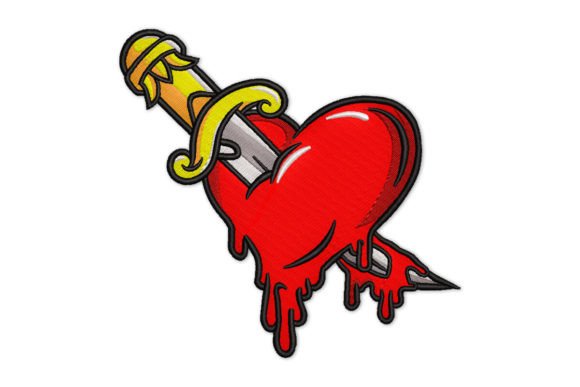
Dagger and Bloody Heart
First Impression: Bold, Edgy, and Unapologetically Memorable
As an embroidery designer who’s curated over 200 craft fair booths—and watched thousands of shoppers pause, point, and reach for a product—I can tell you Dagger and Bloody Heart lands with immediate presence. It’s not cute. It’s not rustic. It’s not minimalist or farmhouse-friendly. This is bold, gothic-romantic storytelling stitched in thread: a heart pierced by a dagger, rendered with deliberate tension and visual weight. That “slightly ominous” quality in the description? It’s accurate—and it’s precisely why this design cuts through the pastel noise of typical Valentine S Day offerings. For handmade market sellers, that distinction is gold.
Where It Shines: Product-by-Product Reality Check
Tote bags: A standout. Positioned on the lower third of a black or deep burgundy canvas tote, Dagger and Bloody Heart reads as confident, wearable art—not costume. Customers love it as a conversation starter at markets.
Aprons: Works best on solid-color, medium-weight cotton aprons (not striped or busy prints). Centered above the pocket, it adds personality without compromising function. Avoid placing it near seams or curved hems where stitch distortion can blur the dagger’s tip.
Tea towel embroidery: Use caution. The intricate line work and dense fill in the heart require tight fabric tension and minimal texture. Opt for smooth, pre-shrunk linen-cotton blends—not thick terry or looped weaves. Test first: on textured towels, fine details vanish.
Embroidered patches: Excellent candidate. As a sew-on or iron-on patch, Dagger and Bloody Heart gains versatility—customers add it to jackets, denim, backpacks. Keep patch size ≥3.5 inches wide to preserve clarity of the dagger’s edge and blood droplet details.
Caps and curved surfaces: Challenging. The design’s symmetry and central negative space don’t adapt easily to dome-shaped caps. Skip unless you’re using a specialized cap frame and have verified stitch stability on scrap fabric.
Fabric pouches & pillow covers: Strong performers—especially in dark fabrics (navy, charcoal, wine) where thread contrast pops. On small pouches (4–6"), use it as a centered focal; on larger pillows (16"+), scale up slightly to avoid looking timid.
Printable mockups & Etsy listings: Photographs exceptionally well against moody, neutral backdrops—think slate, matte black, or raw wood. Pair with one clean lifestyle shot (e.g., the embroidered tote resting beside vintage books and a single red rose) to signal tone and audience fit.
Production Practicality: What Makes It Sellable—And What Slows You Down
Dagger and Bloody Heart is highly legible at a glance—no decoding needed. That’s rare for edgy designs. Shoppers instantly grasp the motif, emotion, and intent. As a machine embroidery design, it functions well both large (as a statement piece) and mid-scale (3–4" wide), but avoid shrinking it below 2.75". Tiny hearts lose definition; thin dagger lines risk skipped stitches or thread breakage.
Stitch density is likely moderate-to-high in the heart’s fill and dagger’s blade—common for “intricate” designs. That means: plan stabilizer carefully. A medium-weight cutaway works best for stable fabrics like cotton twill or linen; lightweight tear-away may shift under dense stitching. Always test the embroidery file on your target fabric before batch production.
Thread colors matter more here than in whimsical motifs. Rich burgundy or black for the heart, metallic gunmetal or charcoal gray for the dagger—these elevate perceived value. Avoid pastel reds or shiny golds; they dilute the mood.
Careful-Use Notes You Can’t Skip
- Dense stitch areas (heart interior, dagger hilt) demand precise tension—check your machine before running 50 units.
- Tiny details (blood droplets, subtle shading in the heart) will disappear on dark fabric unless paired with high-contrast thread (e.g., bright crimson on black).
- Curved or uneven surfaces (caps, some pouch seams) distort the symmetrical balance—confirm hoop size compatibility and test on scrap first.
- Thick or napped fabrics (terry cloth, fleece, heavy denim) obscure fine line work—reserve this design for smooth, tightly woven substrates.
- Small sizes (<2.5") sacrifice emotional impact and readability—don’t force it onto tiny keychains or enamel pins.
Booth & Brand Impact: Why It Moves Inventory
In a sea of floral monograms and “Love You to the Moon” slogans, Dagger and Bloody Heart creates instant booth differentiation. It attracts a specific, engaged buyer: fans of alternative aesthetics, goth-adjacent romance, tattoo-inspired textiles, and collectors of intentional handmade products. That focus builds trust—and repeat traffic.
It raises perceived value: customers pay more for pieces that feel conceptually cohesive and skillfully executed. When stitched cleanly on a premium tote or linen pouch, it reads as collectible—not craft-fair ephemera. For Etsy sellers and small shop owners, it strengthens brand consistency if your shop leans into moody, narrative-driven design assets.
Most importantly, it sparks engagement. I’ve watched buyers linger, ask about symbolism, snap photos, and tag friends. That organic interaction multiplies visibility—both in-person and online.
Designer-to-Designer Must-Dos Before You Embroider
- Test the embroidery file on scrap fabric matching your final product—especially for texture, weight, and color.
- Check thread contrast: lay actual thread on fabric swatches under natural light before digitizing or stitching.
- Review spacing between dagger and heart—tight gaps may merge in stitching; adjust if needed for clarity.
- Confirm hoop size compatibility with your embroidery machine and intended product (e.g., large hoops for pillow covers, smaller for patches).
- Inspect stitch density visually—look for potential puckering or thread nesting in the heart’s center.
- Choose stabilizer intentionally: cutaway for stretchy or unstable fabrics; tear-away for crisp cottons.
- Create at least one real-world mockup—not just a digital preview—to assess scale, placement, and emotional resonance.
- Compare how the design reads across multiple fabric colors (black, navy, cream, deep red)—some combinations mute the drama.
- Verify commercial licensing terms before selling finished products—this is essential for all digital embroidery files used in small shop products or craft fair inventory.