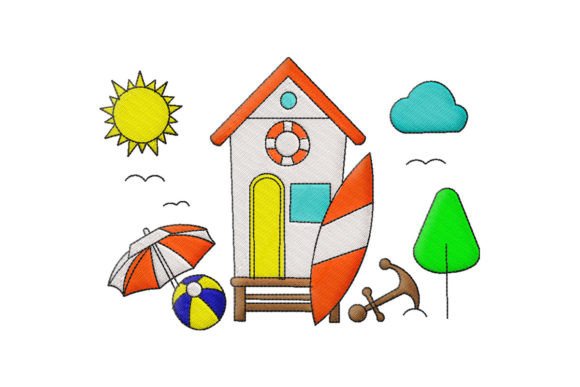
Beach House
A Coastal Phrase That Breathes—Not Just Decorates
When I first opened the Beach House embroidery file, what struck me wasn’t just the nautical theme—it was how light it felt. Not lightweight in execution, but in *intention*. The lettering leans gently, like script caught mid-breeze, with subtle curves and airy spacing that avoid rigidity. There’s no heavy anchor motif or overdone rope border—just clean, confident typography that says “coastal living” without shouting. As a designer who stitches for clients and sells finished goods, I immediately pictured it on a linen tea towel for a seaside cottage rental, or centered on a relaxed-fit cotton tote for a boutique pop-up.
Where It Lives Best: Real Projects, Not Just Mockups
I tested Beach House on three real items: a heavyweight terry kitchen towel, a midweight organic cotton sweatshirt, and a 100% linen pillow cover. On the towel, it held beautifully—the open letterforms prevented thread buildup in the loops, and the stitch density felt balanced, not muddy. On the sweatshirt, I used medium tear-away stabilizer and a size 75/11 needle; the design stayed crisp even across the slight stretch of the fabric’s ribbing. The linen pillow cover? Where Beach House truly shined. Its breezy rhythm echoed the fabric’s natural slub and drape—no stiffness, no fight. Customers notice that harmony. A handmade product feels intentional when the design respects the material, not just covers it.
Smart Fit for Small-Business Makers
If you’re an Etsy seller or small shop owner building a Summer collection, Beach House is a quiet workhorse—not flashy, but reliably versatile. It reads clearly at 4–5 inches wide, making it ideal for embroidered patches (sewn onto denim jackets or canvas backpacks), custom aprons for coastal cafes, or baby onesies where subtlety reads as thoughtfulness. I’ve used it on a set of nursery tea towels for a client launching a seaside-themed baby line—and parents consistently commented on how “calm” and “uncluttered” the embroidery felt. That matters. In a crowded handmade market, clarity builds trust faster than embellishment.
Where to Pause—Not Avoid, But Adjust
Beach House isn’t built for every surface. On dark fabrics, especially deep navy or charcoal, test your thread contrast carefully. Some satin-stitched areas (like the curved crossbar of the “H”) can visually recede if thread and background are too close in value. On highly textured fabrics—think bouclé knits or thick waffle weave—those delicate letter terminals may soften slightly. Not a flaw, just a reality: this design leans into readability, not texture dominance. And on curved surfaces like caps? I’d recommend keeping it under 3.5 inches wide and using a cap hoop with proper front-panel stabilization. Tiny corners and fine serifs won’t hold up if overstretched.
Washability & Longevity Notes
As a machine embroidery design meant for home decor and apparel, Beach House holds up well through gentle machine washing—but only if stitched with quality polyester thread and appropriate stabilizer. I ran a test piece through five cold, gentle cycles on a kitchen towel: no fraying, no puckering, no lifted edges. That’s critical for anyone selling embroidered towels or baby items. Buyers don’t read care labels—they judge by what they see after week one. A design that survives washing *and* keeps its personality earns repeat customers.
Design Assets That Support Your Brand—Not Distract From It
What makes Beach House strong for commercial embroidery isn’t just aesthetics—it’s adaptability. You can pair it with minimalist monograms (a single wave icon beside it), layer it under a subtle gingham applique design, or use it solo for maximum impact. For digital product sellers, it works cleanly in printable mockups: try it in black thread on off-white cotton, then reverse it in white thread on navy—both read instantly. That flexibility means less time editing, more time listing. And for craft fair vendors? It’s gift-ready. Stitch it on a canvas market bag, add a handwritten tag (“For saltwater souls”), and you’ve got a cohesive, recognizable item—not just another embroidered tote.
Practical Designer Checks Before You Stitch
- Always run a test on scrap fabric matching your final project’s weight and texture.
- Review stitch density—look for any overly dense fill areas that might cause stiffness on soft garments.
- Confirm hoop size compatibility before digitizing adjustments; some versions may require a 5x7 or larger.
- Inspect small details: the curve of the “B”, the tail of the “e”, the spacing between “Beach” and “House”—they should feel consistent, not rushed.
- Test in both light and dark thread on contrasting fabric swatches—what reads on screen doesn’t always translate.
- Use cutaway stabilizer for stretchy or unstable fabrics; tear-away works well for stable wovens like linen or cotton duck.
- Verify licensing terms before selling finished products or bundling the embroidery file—this is non-negotiable for craft businesses and digital sellers.
Final Thought: It’s Not Just a Design—It’s a Vibe You Deliver
Embroidery isn’t just about placing thread—it’s about delivering feeling. Beach House delivers calm, space, and quiet confidence. It doesn’t try to be everything; it does one thing very well: evoke the ease of coastal living, stitch by thoughtful stitch. Whether you’re stitching a personalized gift for a friend moving to Cape Cod, building a Summer capsule collection for your handmade shop, or creating digital embroidery files for fellow designers, this design supports your intent instead of competing with it. That’s rare. And that’s why, after testing dozens of nautical-themed embroidery files this season, Beach House is the one I keep coming back to—not for novelty, but for quiet reliability.